
Death toll from Spanish train crash rises as hundreds of services cancelled
- A train collision in southern Spain has resulted in 39 fatalities and 152 injuries.
- The incident occurred on Sunday at 7:45 p.m. local time near Adamuz, in the province of Cordoba.
- A derailing high-speed train collided with a second oncoming train.
- Over 200 train services between Madrid and the southern Andalucia region were cancelled on Monday.
- Prime Minister Pedro Sanchez cleared his agenda for the day in response to the tragedy.
A deadly rail accident shocked Spain on Sunday after two high speed trains collided in the south of the country, causing both to derail and leaving dozens of people dead or injured.
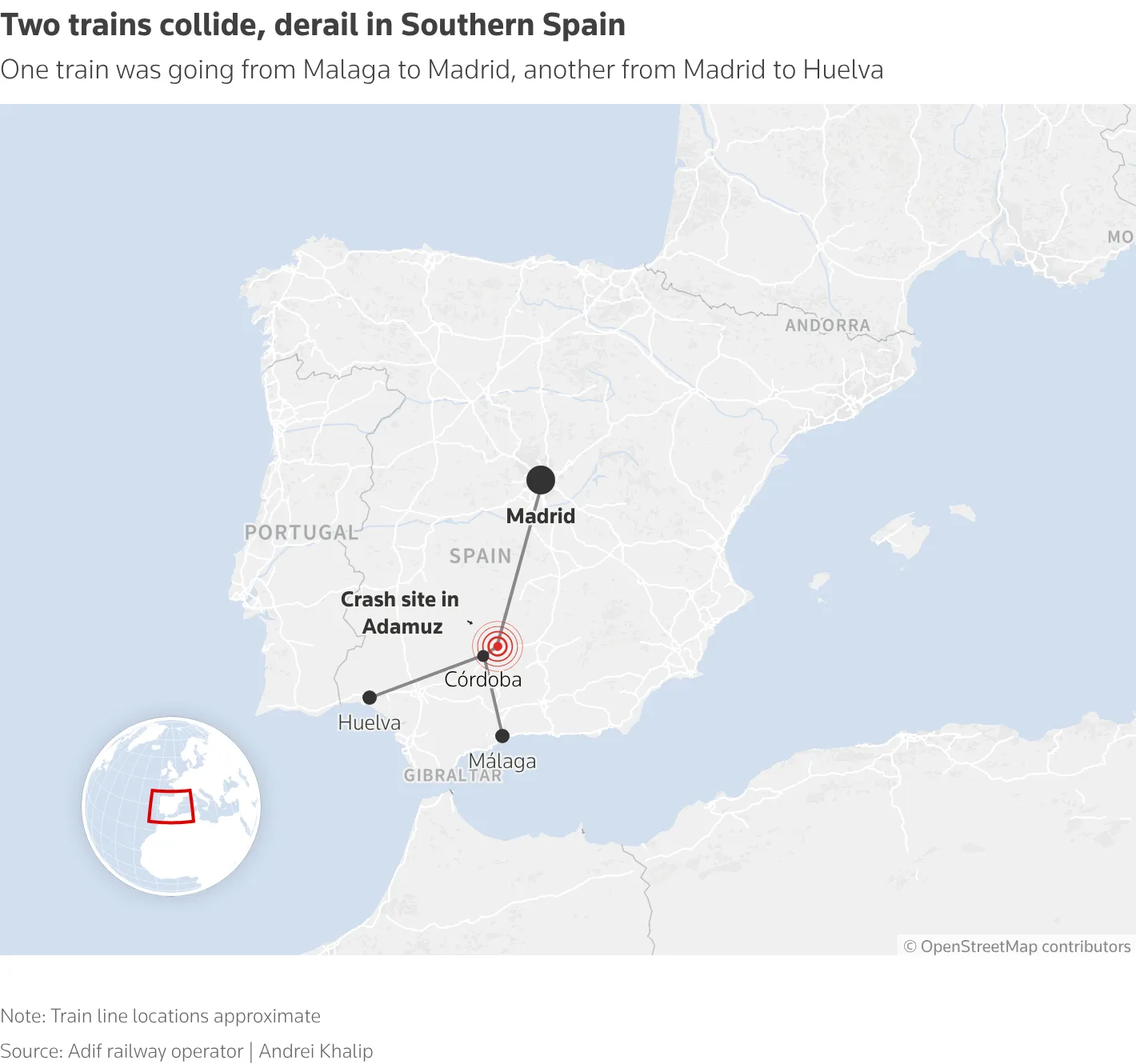
According to Spanish police and emergency responders, the crash happened near the town of Adamuz in Córdoba province. One of the trains, operated by private company Iryo, was traveling from Málaga to Madrid when it derailed and ended up colliding with another train. The second train, a Renfe Alvia service, was heading from Madrid to Huelva and was forced off the tracks, with part of it falling down an embankment.
Many passengers were onboard
Authorities said around 400 passengers were believed to be traveling on the two trains combined. The collision caused serious damage, especially to the front section of the Renfe train, where several passengers were trapped inside the wreckage.
Emergency teams worked through the night and used heavy equipment to reach crushed sections of the trains and rescue survivors.
Casualties and injuries
Initial reports stated that at least 21 people were killed and around 75 were injured. Several of the injured were described as being in critical condition. Officials warned that the number of casualties could rise as rescue operations continued and more details were confirmed.
National response and service suspension
Spain’s leaders expressed sorrow after the tragedy, while transport authorities suspended rail services between Madrid and Andalucía as investigators began reviewing what caused the crash.
Officials also described the incident as unusual because it happened on a straight section of track that had reportedly been recently renewed. That detail has raised additional questions about whether the cause was linked to train systems, track conditions, signaling issues, or another unexpected failure.
Locals stepped in to help
Local residents reportedly helped emergency teams by assisting survivors and supporting victims at nearby safe locations until medical transport arrived.
What happens next
Rescue and recovery operations are continuing, while police and transport investigators examine the derailment and the moments leading up to the collision. Authorities are expected to release more information as the investigation progresses and the transport system is assessed for safety.
Still People Trapped
The crash happened at 7:45 p.m. (18:45 GMT), just around 10 minutes after the Iryo train left Córdoba on its way to Madrid, authorities said.
Adif, the agency that manages Spain’s rail network, said the Iryo 6189 train from Málaga to Madrid derailed near Adamuz and crossed onto the nearby track. Moments later, it struck a second train traveling from Madrid to Huelva, forcing that train off the rails as well.
Spain’s transport minister Óscar Puente said most of the people who were killed or injured were sitting in the first two carriages of the Renfe Alvia train. He explained that the first carriage had 37 passengers onboard, while the second had 16.
Officials said the Iryo train was carrying more than 300 passengers, while the Renfe train had around 100.
Córdoba fire chief Paco Carmona told Spain’s national broadcaster TVE that passengers from the Iryo train were evacuated within hours. However, he said the Renfe carriages suffered far heavier damage, with wrecked seating and twisted metal throughout.
He added that rescue teams were still trying to reach trapped passengers. According to Carmona, the focus was on pulling people out of extremely tight spaces inside the damaged carriages, which made the operation slow and difficult.
He also said crews had to remove bodies in order to access areas where survivors could still be trapped, calling the rescue effort highly complex and emotionally demanding.